
Groundworks Contractors in the North East
Groundworks is where a job is won or lost. Get the dig, the concrete and the drainage right and everything above it goes smoothly. Get it wrong and you are paying for it for the next thirty years.
This is the trade the business started on, so it is the one we are hardest on ourselves about. Building control get out to inspect the trench before any concrete goes in, every time.
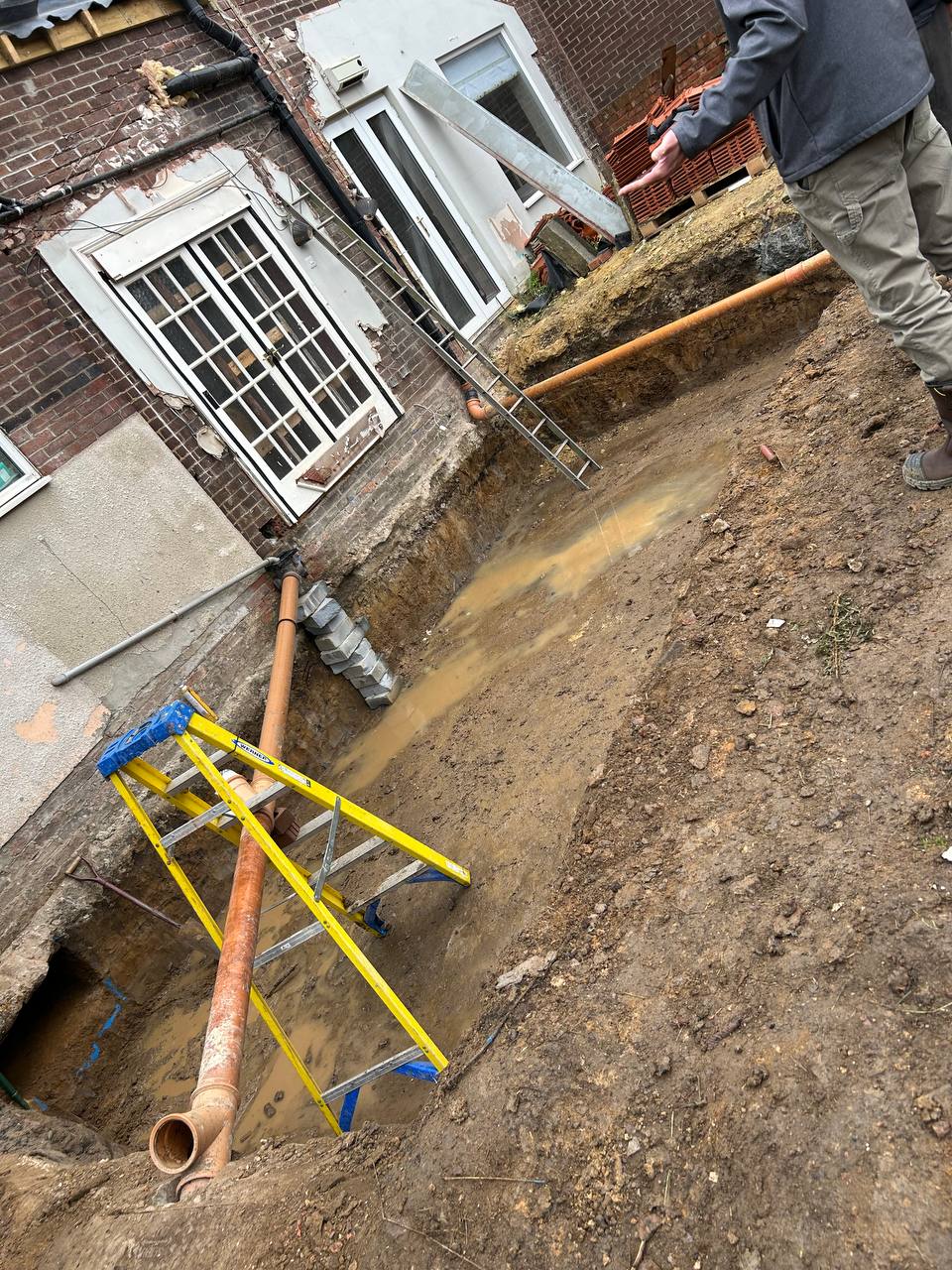
What we take on
- Site clearance, reduced dig and muck away
- Strip, trench fill and pad foundations
- Below-ground blockwork up to damp course level
- Foul and surface water drainage, manholes and connections
- Soakaways and land drainage
- Oversite, hardcore, sand blinding, membrane and slabs
- Service ducting and trenching
How we do it
Set out
Levels taken off the drawing and pegged out. We check the drainage runs and invert levels before anything gets dug, because that is when a problem is cheap to solve.
Dig
Down to good bearing ground. In this region that can be anything from a metre of made ground on old colliery land to solid clay at 900mm. We tell you the moment depth changes, not after the concrete lorry has been.
Building control inspection
Trench inspected and signed off before pour. Non negotiable.
Concrete and blockwork
Correct mix for the ground conditions, sulphate resisting where the ground calls for it. Blockwork up to DPC, cavity filled and trays where needed.
Drainage and oversite
Falls checked with a level, air tested where required, then hardcore, blinding, membrane and slab.
What it tends to cost
Excavation is priced by volume and by how far the muck has to travel. Around here the two things that blow a groundworks budget are made ground, which means digging deeper than the drawing says, and running into unrecorded services or old colliery workings. We build a realistic depth into the quote and tell you the rate if we have to go further, so there is no argument on the day.
Questions we get asked
How deep do foundations need to be?
Building Regs minimum is 450mm in most ground but that is rarely what you end up with. In clay you are typically at 900mm to 1000mm to get below seasonal movement, and if there are trees nearby it goes deeper again, sometimes 1.5m or more depending on species and distance. On former colliery land in Durham or the Sunderland coalfield you can hit made ground and need to go a lot further. Building control has the final say on site.
Do I need building control involved for an extension foundation?
Yes, always. The trench has to be inspected before concrete goes in. Skipping it means you have no sign off, and that will come back to bite you when you sell the house. It is one of the first things a buyer's solicitor asks for.
What happens if you find an old drain or a mine shaft?
Old drains are common and usually just a re-route, which we would price as a variation before doing it. Mining features are a bigger deal and this region has plenty. If we hit anything that looks like a shaft or old workings, everything stops and it goes to the Coal Authority. It is not a corner anybody should cut.
Where we cover for groundworks
Other trades we cover
Want a price on groundworks?
Send a few details or give us a ring. We will come and look at it, and you get a written price with no obligation attached.